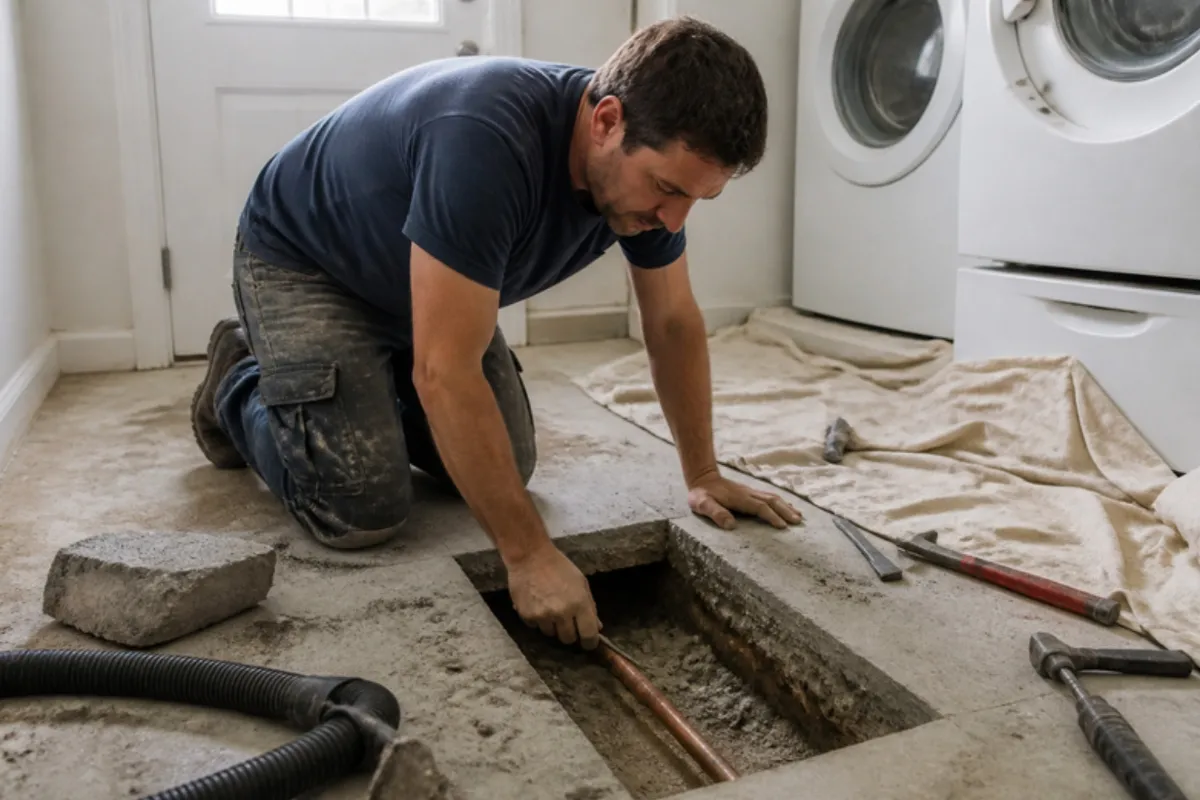
A slab leak is a supply pipe that has failed beneath or within a concrete floor. The usual fixes are cutting a small opening to repair the pipe, abandoning that run and rerouting new pipe overhead or through walls, or replacing the piping in that part of the house. Call the number on this page to be connected with a local plumber in Denver.
Signs worth taking seriously
- One patch of tile, vinyl or bare concrete that feels warm underfoot
- A faint hiss or trickle you only hear late at night
- Carpet that stays damp, or baseboards and laminate starting to swell
- A water heater cycling more than it used to
- A Denver Water bill climbing while your habits stay the same
A five-minute check you can do yourself
Turn off every fixture, the ice maker and the sprinkler controller. Find the meter and watch its leak indicator for a few minutes. If it moves, something is running. Now close the main valve where the supply enters the house. A meter that goes still points to a leak inside the home. A meter that keeps turning points outside, to the buried service line between the meter and the house, which Denver Water says belongs to the property owner and is handled as a water line repair instead.
Where slab leaks come from in Denver homes
Only floors poured directly on the ground can hide one, so this mostly applies to slab-on-grade houses, additions and finished lower levels with pipe set in concrete. Denver's housing skews older, with a median year built of 1975 and roughly 55.5% of homes built before 1980. In older piping, corrosion and worn joints are the usual suspects. In newer slabs, a leak is more often a fitting that was stressed during the pour or pipe chafing against concrete as it expands and contracts.
How a plumber finds the spot
The first step is isolating hot from cold to learn which side is losing pressure. From there, acoustic listening gear picks up the sound of water escaping, and a thermal camera helps trace a hot line. The tighter the locate, the smaller the opening in your floor.
Choosing a repair
| Option | Best for | What you give up |
|---|---|---|
| Open the slab at the leak | A single failure in otherwise healthy pipe | Flooring and concrete are cut and patched |
| Reroute the line | Pipe under the slab that is hard to reach or likely to fail again | Small openings in drywall or ceilings instead of the floor |
| Replace the piping | Several leaks or pipe at the end of its life | Bigger project, but it removes the next weak spot |
What drives the price
Locating time, the floor covering over the leak, the repair you pick and how much drying the area needs all move the number. Flooring is usually its own trade. Ask the plumber whether the work needs a permit from Denver Community Planning and Development and who will apply.
Slab Leak Repair questions from Denver homeowners
How can I tell if the leak is under the slab or out in the yard?
Will the plumber have to jackhammer my floor?
Can a house with a basement have a slab leak?
Is the buried line from the street my responsibility in Denver?
Related plumbing services in Denver
Helpful guides
Slab Leak Repair in nearby cities and towns
Arapahoe County
Jefferson County
Adams County
Douglas County
Broomfield County
Boulder County
Weld County
Elbert County
Park County
Gilpin County
Clear Creek County
Sources
Last updated: