Denver Water describes its supply as soft to moderately hard, with harder water in the southern part of its system and during winter, so whether a softener pays off depends on your address and your own test. Many people who ask about treatment actually want a better taste, which is a filter job rather than a softener job. Call the number on this page to be connected with a local plumber in Denver who can install the system your results point to.
How hard is Denver water?
All of Denver Water's supply is surface water, mostly mountain snowmelt collected on both sides of the Continental Divide. The utility says the result is soft to moderately hard. Water from its southern collection system runs moderately hard, while the northern system is somewhat soft. Hardness also shifts with the seasons: it climbs a little in winter, when reservoirs and streams are frozen and pick up more minerals, and eases from late spring through fall as runoff dilutes them.
Denver Water notes that hardness is not a health issue and that its water tends to leave scale over time. It does not recommend a household softener. That makes a quick hardness test at your own faucet the sensible first step before anyone sells you equipment.
Match the equipment to the problem
| What bothers you | What usually fixes it |
|---|---|
| White crust on faucets, glass doors and kettles | A softener, if a test confirms meaningful hardness |
| Chlorine-like taste or odor | Carbon filter rated for chloramine, whole-house or under-sink |
| Want cleaner drinking water at one tap | Under-sink filter or reverse osmosis |
| Fish tank or aquarium use | Dechloraminating treatment, since Denver Water disinfects with chloramine |
A softener exchanges calcium and magnesium for sodium or potassium. It does nothing for chloramine, so it will not change how the water tastes in that respect.
Permits and installation
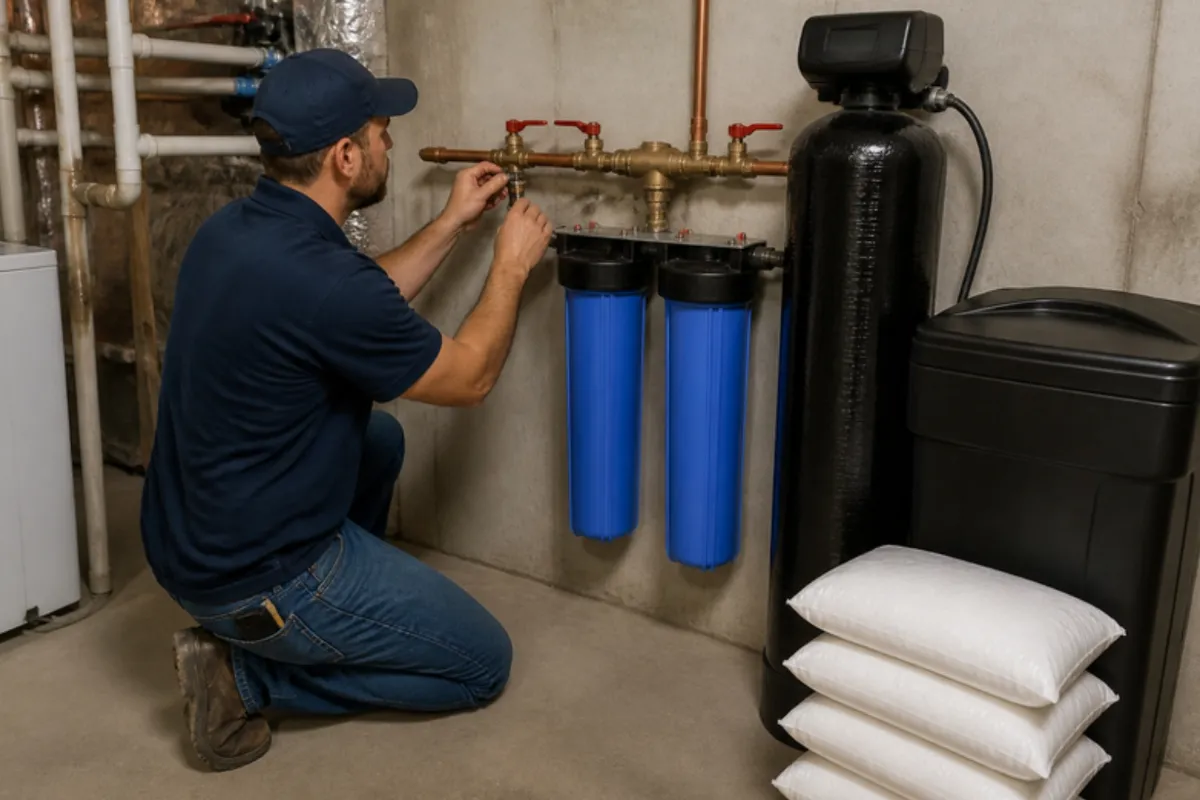
In single-family homes and duplexes, a water softener is one of the plumbing jobs Denver Community Planning and Development handles as a quick permit, applied for online through e-permits. A typical install includes:
- Tying into the main line after the house shutoff, with a bypass valve so the unit can be serviced.
- A drain connection with a proper air gap for the regeneration cycle.
- An outlet nearby for the control head.
- An unsoftened cold line to the kitchen if anyone in the house limits sodium.
What drives the price
Cost depends on the type and capacity of the system, whether it treats the whole house or one tap, how easy it is to reach the main line, how far away the drain and power are, the permit, and ongoing salt, filter cartridges or membranes. A plumber can quote once the location and equipment are settled.
Water Softener questions from Denver homeowners
Does Denver tap water need a softener?
Why does my water seem harder in winter?
Will a softener take out the chloramine?
Do I need a permit to install a softener in Denver?
Related plumbing services in Denver
Helpful guides
Water Softeners & Filtration in nearby cities and towns
Arapahoe County
Jefferson County
Adams County
Douglas County
Broomfield County
Boulder County
Weld County
Elbert County
Park County
Gilpin County
Clear Creek County
Sources
Last updated: